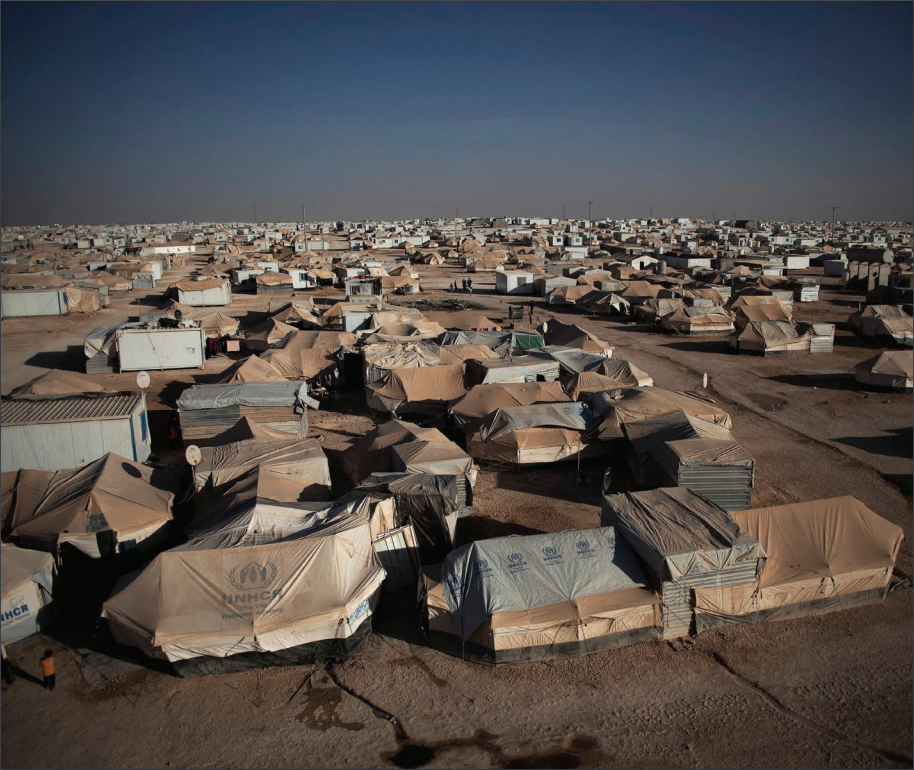
Zaatari: The Instant City
We have been actively engaged in the larger dialogue on issues of post-disaster resettlement and reconstruction for some time and are participating in the implementation of several projects within this sector. We first learned of Zaatari about several years ago and found the situation in Zaatari particularly infuriating. As a result, we hired a terrific Harvard Graduate School of Design (GSD) student, Alison Ledwith, to document what Zaatari is, and what it is becoming, during her winter internship this past January. The product of her work seemed so important to share that we chose to publish it, at AHI’s expense.
Though considered to be a temporary settlement, Zaatari is one of the largest and fastest-growing cities in Jordan, housing more than 120,000 Syrian refugees on a 2-square-mile plot of desert and costing $500,000 a day to run. Instant cities like Zaatari are not acknowledged as such, even though they last an average of 17 years and currently house 45 million people worldwide. The AHI Zaatari book brings home this dreadful reality; we want it to spur change.
Right now, relief-oriented agencies focus on the immediate delivery of humanitarian goods; no one looks at the place as a city-in-the-making. We want policy makers and humanitarian agencies to see themselves as urban-planners-on-fast-forward, to reshape the agenda from immediate relief to accelerated renewal, and to create conditions where the new settlement that arises is acknowledged as an urban condition that can benefit from investment as well as charity.
This book would never have been completed without the help and support of another incredible GSD student intern Joyce Lee, Associate Anya Brickman Raredon, and Analyst Molly McGowan. Special thanks is due to the generous individuals and organizations that gifted us their photographs, especially: Luke Vargas, Dalia Khamissy, Rachel Smalley, The REACH Initiative, CNES, Oxfam, NASA Earth Observatory, UNHCR, The Jordan Times, UNOSAT, and Stars and Stripes.
If you are interested in supporting us in these efforts, we are also seeking donors to sponsor the printing and distribution of books. We will use donations to distribute physical books for free at regional and global conferences on the topics of humanitarian relief work and urban development after disasters. We can also send the books to anyone in the world whom our donors request, with the donor’s compliments.
We have been actively engaged in the larger dialogue on issues of post-disaster resettlement and reconstruction for some time and are participating in the implementation of several projects within this sector. We first learned of Zaatari about several years ago and found the situation in Zaatari particularly infuriating. As a result, we hired a terrific Harvard Graduate School of Design (GSD) student, Alison Ledwith, to document what Zaatari is, and what it is becoming, during her winter internship this past January. The product of her work seemed so important to share that we chose to publish it, at AHI’s expense.